Sacramento County Transportation Development Fee and Transit Impact Fee (SCTDF/TIF)

FY 2021-2025 Five-Year Report

December 9, 2025
Prepared for: County of Sacramento Board of Supervisors
Prepared by: County of Sacramento Department of Transportation


SCTDF Five-Year Report Fiscal Years 2020/21- 2024/25

A. Identify the purpose to which the fee is to be put

The purpose of the Sacramento County Transportation Development Fee (SCTDF) Program is to help fund improvements to the County’s major roadway, bicycle and pedestrian facilities that are identified in the 2019 Update SCTDF/TIF Program Nexus Study (“2019 SCTDF/TIF Program”) as necessary to accommodate travel demand generated by new land development in the unincorporated portion of Sacramento County through 2050. The fee ensures that new development contributes their fair share to fund improvements to existing transportation facilities that are needed to mitigate the impact of increased growth.

In April 2019, the SCTDF Program had a major nexus update including the addition of a “Transit Impact Fee” (TIF) for specific Sacramento Regional Transit (SacRT) transit projects also triggered by future development impacts. Therefore, the SCTDF was renamed to the SCTDF/TIF. The County began collection of the TIF on June 22, 2019, on behalf of SacRT. The TIF is kept in its own account and dispersed to SacRT twice a year for use towards their SCTDF/TIF transit projects, as such the SCTDF and the TIF have their own separate annual and Five-Year reports. 

B. Demonstrate a reasonable relationship between the fee and the purpose for which it is charged

The SCTDF roadway capacity improvements identified in the 2019 SCTDF/TIF program are intended to meet new travel demand associated with 2050 development forecasts in the unincorporated portion of Sacramento County prepared by the Sacramento Council of Governments (SACOG).

This projected growth in housing and employment will increase travel demand throughout the unincorporated County and thereby require infrastructure improvements for all travel modes to sustain an acceptable level of service (LOS) in accordance with the County’s General Plan and applicable County policies. The total amount of the SCTDF (non-TIF) transportation improvements that would be funded through the SCTDF/TIF Program is about $2.84 billion.

For roadways and intersections that currently operate at LOS E or better conditions, the entire cost of the capacity improvements (minus funding from other sources) are allocated to the SCTDF Program. For existing deficiencies (roadways that currently operate at LOS F), the cost of the improvement that is allocated to the SCTDF Program is equal to the percentage of the total change in volume/capacity (v/c) ratio due to the improvement that is needed to return the v/c ratio to current levels.

For each of the roadway improvement projects, the estimated percentage of new vehicle trips by fee district that would use those roadways determines each district’s cost responsibility for the improvements. The percentage use of new vehicle trips on roadways operating at LOS F was used to allocate the cost responsibility of transit, Intelligent Transportation Systems (ITS) improvements, and walkway and bikeway improvements along those congested roadways. This analysis establishes a proportionate relationship between the cost responsibility of each fee district for roadway improvements and the travel demand generated by that district.

In the allocation of costs to various types of developments, each development type is assigned a “dwelling unit equivalent” or “DUE” rate, which measures how the trip-making characteristics of a land use compare to a single-family residential unit. The cost responsibility for each fee district was divided by the dwelling unit equivalents (DUEs) in that district to determine the cost per DUE. This analysis identifies each DUEs fair share financial contribution to cover the costs of the needed improvements.

The County has development fee programs in several “special financing districts” to fund major infrastructure within or near those districts including roadway improvements. Some of the roadway capacity improvements that are funded by the special financing districts are also included in the SCTDF/TIF Program Update. The cost responsibility for each special financing district was reduced in the SCTDF/TIF by the amount that is funded by that district to eliminate any overlap between the fee programs.

The total cost responsibility for each fee district was divided by the dwelling unit equivalents (DUEs) in that district. The SCTDF fee for each fee district, special financing district, and fees for Affordable Housing are provided in SCTDF/TIF Annual Report, Fiscal Year (2024-25), Exhibit B, Pages 10-12. The methodology illustrates the reasonable relationship between the SCTDF fee and the purpose for which it is charged. 

C. Identify all sources and amounts of funding anticipated to complete financing in incomplete improvements identified in the SCTDF Program

The SCTDF roadway related projects (non-transit) in the 2019 SCTDF/TIF were determined from a 30-year nexus impact study through 2050, to identify transportation infrastructure needs triggered by these new development impacts. The projected roadway impacts will require $2,844,421,583 in SCTDF project funding to mitigate (see table below).  
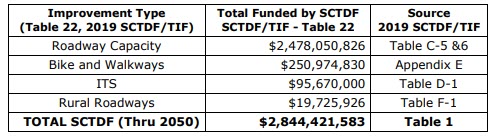
Table details the SCTDF project funding to mitigate

In addition to this projected SCTDF funding from new development fees, the County will supplement the $2,844,421,583 with an additional $817,127,776 of funding from other sources (per 2019 SCTDF/TIF, Tables 18 and 19). These additional funding sources can include: Measure A Sales Tax; State and Federal Grants; SB1; Special Finance Districts (as stated above), adjacent jurisdictions, and other miscellaneous sources. The entire list of SCTDF projects for the next 30 years are identified in the 2019 SCTDF/TIF nexus study as noted in the table above.

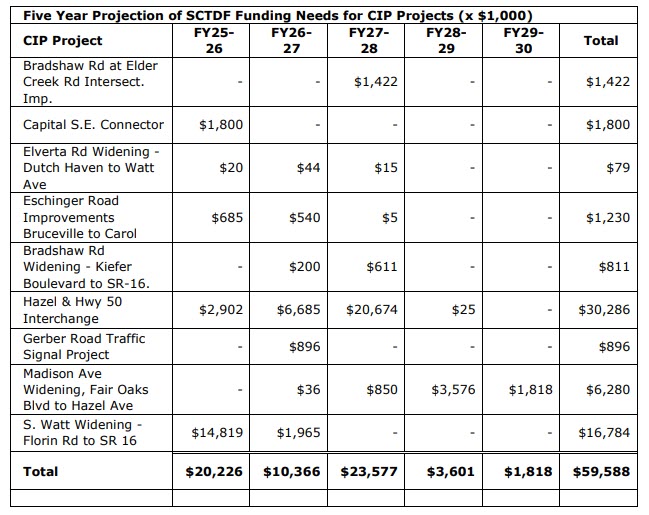
The County identifies the highest priority roadway needs listed in the 30 year list of SCTDF roadway projects into an annual five year plan, the “Capital Improvement Plan” (CIP). The currently approved Fiscal Year 2025-26 CIP identifies $59,588,000 of SCTDF funding that is needed to complete the following high priority SCTDF Projects from Fiscal Year 2025-26 through Fiscal Year 2029-30:

5 Year Projection Of SCTDF Funding Needs for CIP Project

D. Designate approximate dates when revenue in Part C (above) is expected

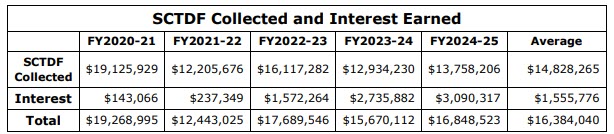
As shown in the table above, the SCTDF revenue needed to satisfy the Fiscal Year 2025-26 CIP for the next five years would be $59,588,000. At the beginning of Fiscal Year 2025-26, there was a beginning available SCTDF fund balance of $85,299,426.78. In Fiscal Year 2024-25 the County collected $13,758,206 in SCTDF funds, and $3,090,317 in annual interest was earned, totaling $16,848,523. However, over the last five years (per table below) the County has collected an average of $16,384,000 (SCTDF fees and interest) per year.

SCTDF Collected and Interest Earned

Assuming this previous five-year average shown above were to continue for the next five years (through FY 2029-30), then $167,219,427 (5 x $16,384,000 + $85,299,427) would be available to satisfy the Fiscal Year 2029-30 CIP projection of $59,588,000. 


TIF Five-Year Report (FY 2020-21 – 2024-25)

A. Identify the purpose to which the fee is to be put

The purpose of the Sacramento County Transportation Development Fee/ Transit Impact Fee (SCTDF/TIF) Program is to help fund improvements to the County’s major transit facilities that are identified in the 2019 Update SCTDF/TIF Program Nexus Study (2019 SCTDF/TIF Program) as necessary to accommodate travel demand generated by new land development in the unincorporated portion of Sacramento County through 2050. The fee ensures that new development contributes their fair share to fund improvements to existing transit facilities that are needed to mitigate the impact of increased growth.

In April 2019, the SCTDF Program had a major nexus update including the addition of a “Transit Impact Fee” (TIF) for specific SacRT transit projects also triggered by future development impacts. Therefore, the SCTDF was renamed to the SCTDF/TIF. The County began collection of the TIF on June 22, 2019, on behalf of SacRT. The TIF is kept in its own account and dispersed to SacRT twice a year for use towards their SCTDF/TIF transit projects, as such the SCTDF and the TIF have their own separate annual reports. Since Fiscal Year 2019-20 was the first year of collecting the TIF, the TIF is included in this Five Year Report.

B. Demonstrate a reasonable relationship between the fee and the purpose for which it is charged

The TIF transit improvements identified in the 2019 SCTDF/TIF program are intended to meet new travel demand associated with 2050 development forecasts in the unincorporated portion of Sacramento County prepared by the Sacramento Council of Governments (SACOG).

This projected growth in housing and employment will increase travel demand throughout the unincorporated County, as well as the cities in Sacramento County, thereby increasing demand for Sacramento Regional Transit (SacRT) transit services and need for improvements to the regional transit system. To accommodate new development, SacRT will need to increase frequency on some current transit (bus and light rail) routes, extend transit routes and add new transit routes to sustain an acceptable level of service (LOS) in accordance with the County’s General Plan and applicable County policies. The total amount of the TIF transit improvements that would be funded through the SCTDF/TIF Program is about $1.88 billion.

New transit services will benefit existing residents/businesses as well as new development. Some new transit routes would travel from unincorporated areas into cities and thus would benefit residents/businesses in those cities. Thus new development’s “fair share” of these new transit services is based on estimates of who would use those services. New development will need to contribute to a range of new transit infrastructure and equipment. The SCTDF/TIF Program assumes that the cost of this new infrastructure will be partially funded by growth in unincorporated areas of Sacramento County based on an assessment of its usage of expanded transit services versus the usage from growth of cities in Sacramento County.

For each of the transit capital improvements, the percentage of new vehicle trips by fee district was obtained from SACOG’s SACSIM regional model forecasting 2050 traffic volumes and transit ridership based on the SCTDF/TIF growth assumptions. The SACSIM model provided the projected origin and destination of transit riders, which was used to assist in cost allocation between SCTDF/TIF fee districts and between the cities and unincorporated area in Sacramento County. Transit capital improvements are identified in the 2019 SCTDF/TIF Program, Table 11, showing the “fair share” percentages and cost allocation of each of the transit improvement types to be partially funded by the TIF program. 

In the allocation of costs to various types of developments, each development type is assigned a “dwelling unit equivalent” or “DUE” rate, which measures how the trip-making characteristics of a land use compare to a single-family residential unit. The cost responsibility for each fee district was divided by the dwelling unit equivalents (DUEs) in that district to determine the cost per DUE. This analysis identifies each DUEs fair share financial contribution to cover the costs of the needed improvements.

The County has development fee programs in several “special financing districts” to fund major infrastructure within or near those districts including roadway improvements. Some of the roadway capacity improvements that are funded by the special financing districts are also included in the SCTDF/TIF Program Update. The cost responsibility for each special financing district was reduced in the SCTDF/TIF by the amount that is funded by that district to eliminate any overlap between the fee programs.

The total cost responsibility for each fee district was divided by the dwelling unit equivalents (DUEs) in that district. The methodology illustrates the reasonable relationship between the TIF fee and the purpose for which it is charged.

C. Identify all sources and amounts of funding anticipated to complete financing in incomplete improvements identified in the TIF Program

The TIF transit capital improvements in the 2019 SCTDF/TIF were determined from a 30-year nexus impact study through 2050, to identify transportation infrastructure needs triggered by new development impacts. The projected transit capital improvements will require $188,411,786 in TIF project funding to mitigate (see table below). 
Defines Project Funding

In addition to this projected TIF funding from new development fees, SacRT will supplement the $188,411,786 with an additional $242,741,324 of funding from other sources (per 2019 SCTDF/TIF, Tables 11). These additional funding sources can include: Measure A Sales Tax; State and Federal Grants; SB1; Special Finance Districts (as stated above), adjacent jurisdictions, and other miscellaneous sources. The entire list of SCTDF projects for the next 30 years are identified in the 2019 SCTDF/TIF nexus study in the Table 11.

D. Designate approximate dates when revenue in Part C (above) is expected

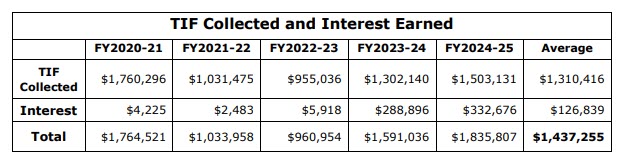
At the beginning of Fiscal Year 2025-26, there was a beginning available TIF fund balance of $7,887,566. In Fiscal Year 2024-25 the County collected $1,503,131.25 in TIF funds, and $332,677 in annual interest was earned, totaling $1,835,808. Over the last five years (per table below) the County has collected an average of $1,437,255 (SCTDF fees and interest) per year.

TIF Collected and Interest Earned table

Assuming this previous five year average shown above were to continue for the next five years (through FY 2029-30), then $15,073,841 (5 x $1,437,255 + $7,887,566) would be available to spend on Transit capital improvements through the Fiscal Year 2029-30.